Are dogs predators? Let’s break it down
Anyone whose German shepherd, border collie or… well, any breed of dog has ever shown its teeth is probably rolling their eyes right now. After all, a dog isn’t a rabbit – it’s a carnivore with hunting in its blood! And of course, according to formal classification, Canis familiaris is a domesticated predator, recognised by some systems as a subspecies of the wolf (though not by all). Rest assured, dear reader, I’m not about to argue that a plant-based diet is the best model for dogs – it isn’t, and there’s no need to call the animal welfare society about this article. However, if you have a dog and want to meet its needs in the best possible way, I invite you on a journey through the history of dog domestication – one that will help you better understand why your four-legged friend feels such a strong need to search for food scraps on the grass, and what alternative you can offer instead!
The dog ‘was’ a predator – evolution and domestication of dogs
There are plenty of misconceptions in the commonly repeated stories about the domestication of dogs. Many people imagine ancient humans sitting by a campfire (with the obligatory cave painting in the background), and one of them pulling a wolf pup from under their clothing – a pup that, once raised among humans, would give rise to dogs bravely hunting alongside Homo sapiens. However, for a behaviourist who works daily with our sofa-dwelling Canis familiaris, or even a volunteer who knows how difficult (and perhaps partly doomed) the task is when a feral dog arrives at a shelter, instinct suggests that something about this picture doesn’t quite add up. And indeed, reality was probably far less exciting.
Raymond and Lorna Coppinger, well-known and respected scientists in the ‘dog world’, used years of research and observation to present a theory much more in line with canine nature and behaviour. The original dog most likely evolved from a wolf or another canid whose pack followed groups of hunter-gatherers and… scavenged the remains of human food. This was therefore a relationship based far less on joint hunting of prey and much more on animals scavenging leftovers and gradually becoming desensitised to human presence. Regardless of the prevailing conditions, socialisation with humans enabled canine ancestors to survive, so natural selection favoured individuals that were less fearful in their behaviour.
To shorten thousands of years of history: we can, to some extent, see how the ancestors of our friends once lived by visiting almost any village, for example in India. These largely omnivorous dogs live in packs beside and among people, and very rarely have the opportunity to hunt anything. The energetic cost of chasing and killing potential prey is disproportionate to the risk of failure and simply not worth it compared to methodically searching for edible scraps. Thus, the population of such semi-feral Indian or African dogs alternates between sniffing around for leftovers, resting, and – as befits social animals – spending time with their own kind, giving us a glimpse into what their ancient life may have looked like.
Predatory instincts in domestic dogs
Does this short history lesson mean that the dog has abandoned its need to hunt? No! Most dog owners will surely agree that some breeds display this instinct more strongly than others – and I can’t wait to expand on the topic of breed division according to their hunting sequence in future articles! But one step at a time. For now, let’s focus on canine hunting behaviours – and how to manage them!
The hunting instinct in dogs
Guardians whose dogs become so excited that they ‘lose contact with the base’ when they smell or see rodents, deer, or other wildlife often lose all enjoyment from countryside walks together. I have to emphasise here that if your companion’s hunting urges are causing problems in your relationship, and the standard obedience skills learned in training don’t work in such situations, it’s worth consulting a behaviourist and considering Predation Substitute Training (PST) based on replacing predatory behaviours.
Nevertheless, most dogs will benefit from play based on the hunting sequence – whether we use it partly (a broader approach with a specialist is still necessary) to meet their predatory needs, or simply to build a better bond.
Harmless ‘predatory’ games for dogs
The canine hunting sequence – that is, the chain of actions leading to obtaining food – consists of:
- Tracking (through sniffing)
- Spotting
- Stalking
- Chasing
- Grabbing
- Tearing apart
- Eating
We’ll deal with food-seeking through sniffing in a moment. For now, let’s focus on creating the recipe for a game that will make our dog overjoyed!
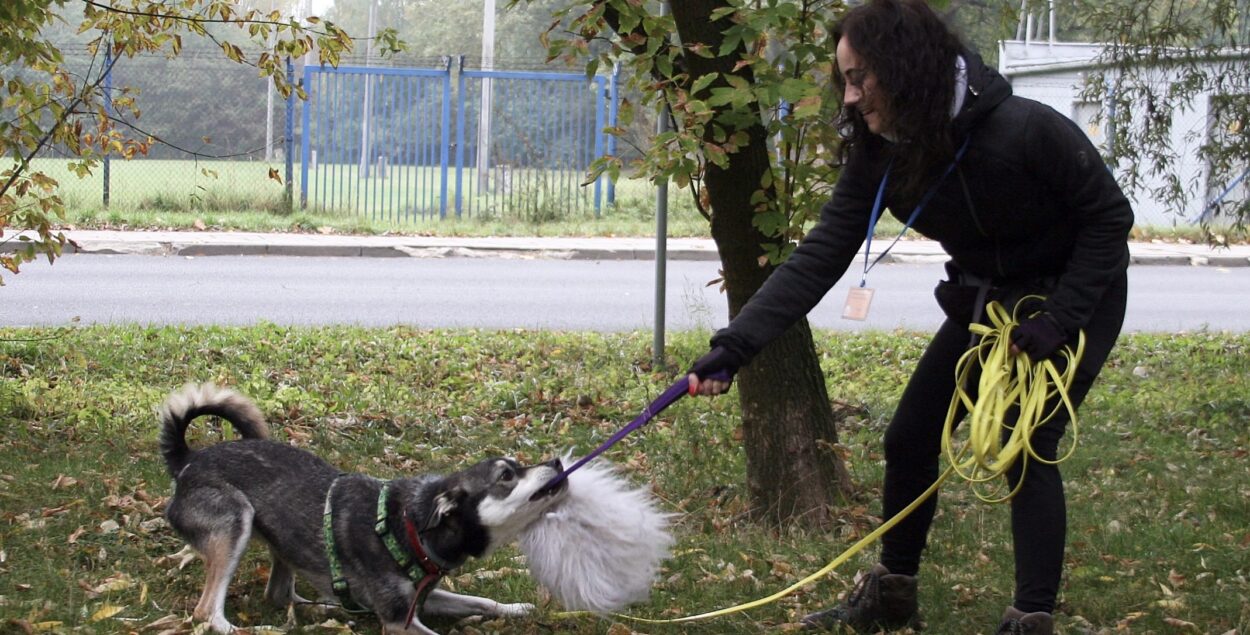
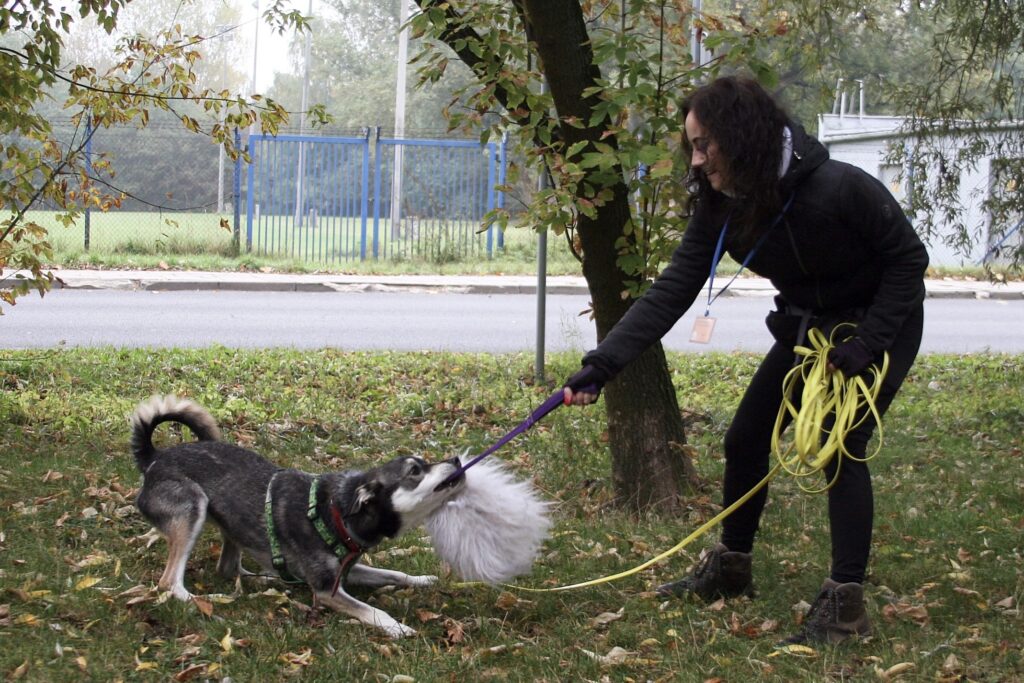
Ingredient one: the right toy! Tug toys made of natural (or artificial) fur are usually very appealing. Don’t worry – not really because they remind the dog of a carcass (which most of our dogs have never seen)! They simply smell interesting, feel soft when grabbed (see point 5), and can be nicely… torn apart (point 6). Buying a tug toy with a long cord will make it easier for us to ‘make it run away’ – thus we also get stalking (point 3) and chasing (point 4). However, I don’t recommend letting dogs eat their tug toys – for point 7, natural chews will come in handy.
Ingredient two: engaging, dynamic play! If we plan to play tug-of-war, first let the dog hunt for the toy! Move it away slowly at first, dragging it along the grass, then faster, making sudden movements. We can also hide the tug toy somewhere, dragging it along the ground beforehand, and then let the dog track it down. Guard dogs may (though not always) prefer spotting a hidden toy, hunting dogs sniffing to find it, while bull-type dogs may be thrilled by tugging with their Guardian. Find out what your dog enjoys most!
Ingredient three: the reward! Remember that every game is about letting your dog win – otherwise, it will quickly lose its appeal. At the end, let your four-legged friend ‘disembowel’ the toy – tearing apart is an important component of predatory satisfaction, and a toy can always be replaced. After the game, it’s worth closing the hunting sequence by giving your dog a bigger treat to eat, allowing them to calm down through chewing.
Communication between dogs and humans
Importantly, dogs may growl, pull at the toy, and so on during exciting tug games. This is not aggression, and the Guardian doesn’t need to feel threatened (although special caution is required when playing with resource-guarding or unfamiliar dogs). It’s a sign of engagement in the activity, so don’t worry – your pit bull joyfully ‘killing’ the tug toy doesn’t mean your household cat is next in line 🙂
Foraging and eating in dogs
At last, we come to active feeding – the topic that prompted me to mention the Coppingers earlier. Hunting aside, how can we satisfy our dog’s essentially genetic compulsion to constantly search for food? Of course, a muzzle may solve the problem of persistently eating rubbish on walks, but what about the need driving that behaviour?
Drumroll, please… and here comes active feeding in all its glory – the daily, controlled acquisition of food, which gives our friend satisfaction while keeping their digestive system intact. Historically, no one placed food neatly in a bowl under a dog’s nose – they had to find it, and many still need to be able to do so. The instinct to obtain food is often at the root of picky eating – dinner in a bowl is easily accessible and simply boring! But dinner… well, where exactly?
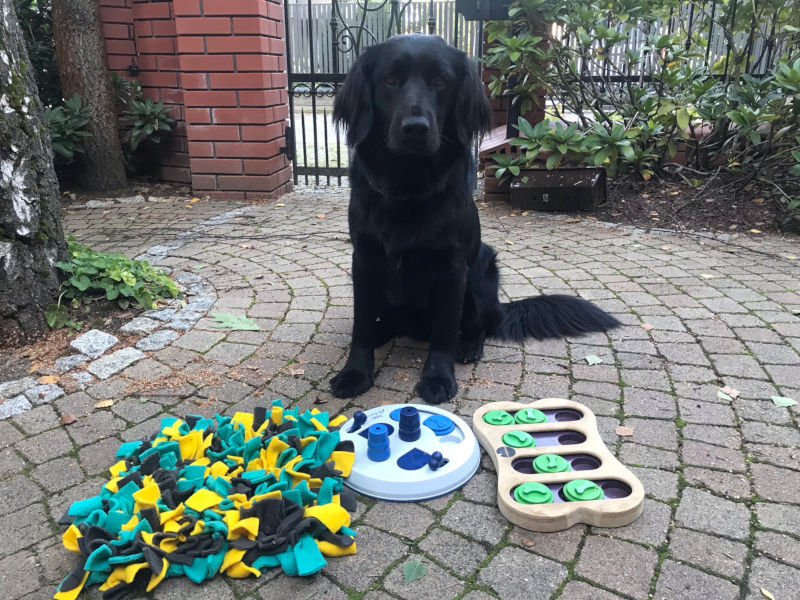
A snuffle mat, a scent ball, a so-called ‘puzzle feeder’ or ‘interactive toy’ from which the dog has to extract food, or even a simple cardboard box filled with toilet roll tubes, or a rolled-up towel with kibble hidden inside – all of these are great ideas for active feeding that encourage sniffing and problem-solving! Even scattering treats in longer grass and encouraging the dog to search for them is a simple way to enrich a walk and a great method to engage your dog’s brain, build motivation, and create positive associations with you and with walks.
Wet food, paste, or blended fruit and vegetables can be spread on so-called lick mats – plastic or rubber mats or toys with grooves or openings from which food has to be licked. This is not only great fun but also helps your dog to eat more slowly, and therefore more healthily and safely.
‘But how come’, you may ask, ‘we make it harder for the dog to eat, and they enjoy it?!’ To some extent, yes. Figuring out how to get to the food, eating smaller portions, and using their nose are all completely natural behaviours, built into the canine ethogram, and help prevent boredom and predictability in what is often a monotonous diet. Moreover, licking, chewing, biting, and sniffing have an extremely positive effect on a dog’s brain – they stimulate the release of neurotransmitters such as dopamine and serotonin, and when managed properly, can be used both for building motivation and for calming purposes. The right level of difficulty in active feeding, gradually increasing the challenge, supporting the dog, and showing them what to do are key factors ensuring the positive impact of such activities, while preventing frustration and discouragement.
Summary
To summarise – the history of the species matters for its needs and behaviour! Searching for human food scraps likely played a fundamental role in the domestication of the dog, and the lives of contemporary semi-wild populations provide an important clue in this regard. We can satisfy some of our dogs’ natural needs by combining games based on the predatory sequence with active feeding. The Internet is a great source of ideas and inspiration, particularly for active feeding – often homemade solutions are the best! I strongly recommend weaving these activities into the daily life of your four-legged companions. Why? Not only does it benefit their fluffy brains, but it’s also a wonderful way to build and deepen your relationship and simply to enjoy good, shared fun!
Sources:
Coppinger, R., & Coppinger, L. (2002). Dogs: A new understanding of canine origin, behavior, and evolution. University of Chicago Press.
Mueller, S. (2023). Hunting together. Predation Substitute Training.
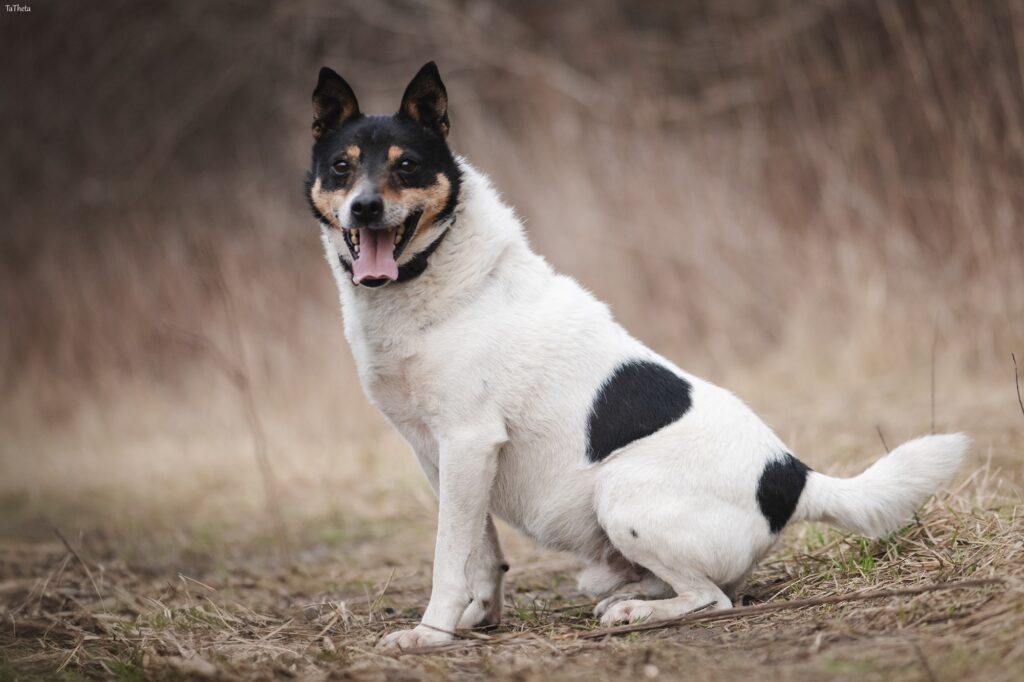
Adoption Corner
Regardless of whether you choose adoption or a dog from a breeder, make your choice consciously. Mutual compatibility is the key to shared happiness. If you decide to choose a mongrel, visit the websites of the ‘Na Paluchu’ shelter (Schronisko Na Paluchu) and the ‘Friends of Paluch’ foundation (Fundacja Przyjaciele Palucha) to find out how to adopt responsibly.
Sniffing, eating, tugging? Jackpot! At the Warsaw shelter, the biggest fan of these activities is waiting for your calls! Meet Sajgon – affectionately called Mr President, Little Cow, or Spring Roll due to his rather… rounded shape (but don’t tell him that, he’ll take offence). Sajgon is a master at thoroughly sniffing every bush, making walks with him calm and relaxing, without unnecessary chasing. To keep things interesting, Sajgon is an expert at playing tug and will happily show you how to have fun with a dog. And food? Well, when it comes to devouring treats, this little dog is unmatched, and the volunteer ladies always fall for his sweet eyes. But it’s not a bad thing – food is the key to Sajgon’s heart, so you’ll win him over easily if you decide to adopt him! Sajgon is a favourite among his volunteers, yet his adoption calls are silent, and this little dog is growing increasingly sad behind the bars… More information about Mr President can be found on his profile à Sajgon 1585/21 | Schronisko Na Paluchu.