Do we have any runners here? Imagine this: you, your dog, and a woodland or mountain trail. You’re running together, surrounded by nature. Sounds like a dream activity, doesn’t it? If so, welcome to this article on canicrossing.
Canicross is more than just running with a dog on a lead – it’s a shared activity full of cooperation, trust, and joy in movement. All you need is a pair of running shoes, suitable harnesses for your dog, a lead, and the desire to spend time with your pet to discover just how much fun a shared running workout can be. This sport combines a passion for physical activity with a love of dogs, building a unique bond and allowing both of you to enjoy nature – side by side, paw in paw.
What is canicross (canicrossing)?
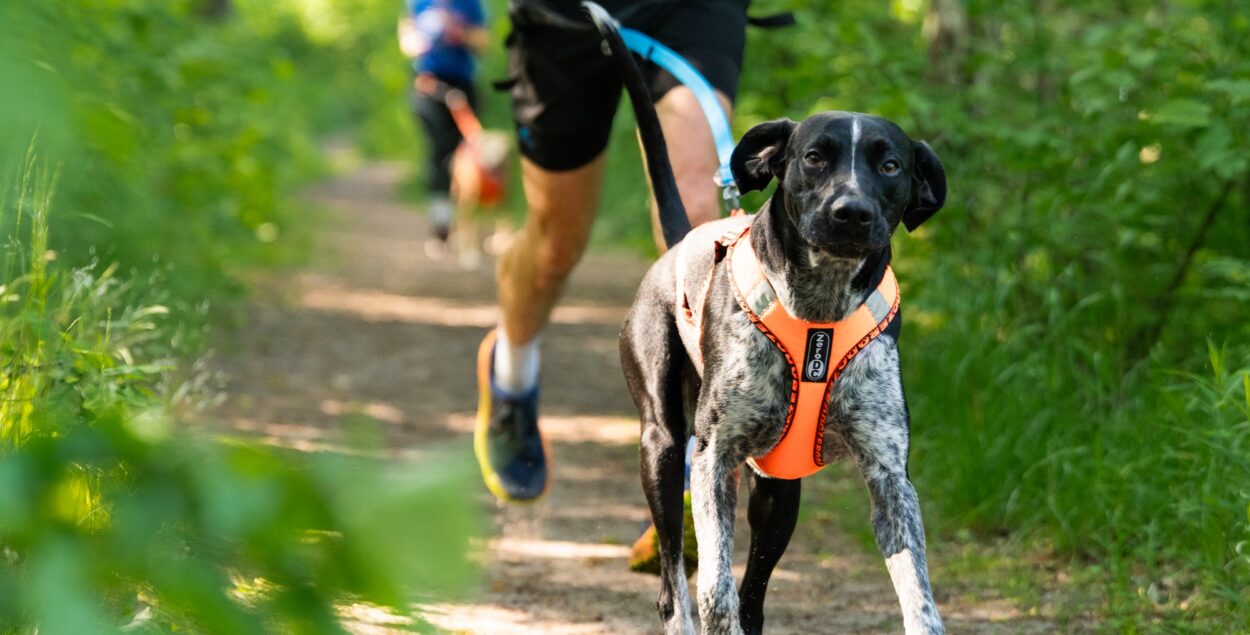
In simple terms, it’s running with your dog. More precisely, it’s an activity derived from sled dog training – the runner and dog form a team, with the dog running ahead, helping the human maintain pace and rhythm.
What sets this joint training apart is that the human and dog are connected by a bungee lead, which attaches to a special dog harness and a hip belt worn by the runner. The dog also has to remain in front at all times and respond to voice commands indicating the direction and pace.
Canicross competitions are held, typically covering distances from 2 to 10 km, with routes usually running through forests or mountains.
Which breeds enjoy running – which should I choose?
It’s a great question – because while almost any dog can take part in canicross, certain types of breeds perform exceptionally well in this sport due to their build, fitness, and willingness to cooperate.
Sled dogs and their mixes
They are natural athletes – born to run and pull:
- Greyster – a cross between a greyhound, a setter, and a pointer; currently the most popular sporting breed in canicross (incredible speed and endurance).
- Alaskan Husky – light, fast, and resilient, bred for sled work.
- Siberian Husky – slower than the greyster but very enduring; excellent for longer distances.
Setters and other hunting dogs
They are highly motivated to move, with great muscles and stamina.
Herding and working dogs
They are great partners for recreational or intermediate-level runners.
Mixed breeds (mongrels)
They often perform very well if they enjoy running and are fitness enough.
You can only start running with a dog of any breed once your pet has been properly introduced to training, conditioned physically, and most importantly, HAS RECEIVED THE GREEN LIGHT FROM AN ORTHOPAEDIC VET AND AN ANIMAL PHYSIOTHERAPIST.
Breeds less suited to canicross:
- Brachycephalic dogs (e.g., bulldogs, pugs, shih tzus) – prone to breathing difficulties, especially during exertion.
- Toy or miniature breeds – can run recreationally (beware of orthopaedic issues and overexertion).
- Heavy molosser breeds (e.g., mastiffs) – too massive for dynamic running.
For dogs prone to joint dysplasia, running may be harmful to their health. For large breeds engaging in this form of exercise, wait several hours after eating, even before a short run, to minimise the risk of gastric torsion.
What equipment is essential for running with a dog?
Canicross harness
When it comes to accessories for running with your dog, this is absolutely fundamental – they must be specifically designed for pulling, not for walking.
Type: so-called pulling/running harness (x-back, h-back, long harness).
Purpose: distributes the pulling force evenly across the dog’s body, protecting the neck and spine.
What to look for:
- should end near the base of the tail (not too short),
- must not press on the chest or restrict the shoulder blades,
- made from lightweight, breathable material,
- well-fitted – the dog must not be able to slip out of it.
Do not use ‘guard’ harnesses, Norwegian-style harnesses, or collars – these can cause pressure and injuries. Consult a trainer if in doubt.
Hip belt (for the human)
Purpose: transfers the dog’s pulling force to the hips and pelvis, relieving the spine and leaving your hands free.
What to look for:
- wide, well-fitted to the hips, with adjustable thigh straps,
- low attachment point (closer to the buttocks) – better control and stability,
- made from breathable material, with shock absorption.
Shock-absorbing line
Connects the dog to the runner and absorbs jerks, protecting both sets of joints and freeing up your hands. A standard collar and lead will not work.
Length: approx. 2–2.5 m when stretched (shorter lines are used for bikejoring/scootering).
What to look for:
- high-quality shock absorber (neither too soft nor too stiff),
- strong carabiners with locks,
- the line should be light yet durable.
Additional but useful items:
- dog boots – for hard surfaces or winter (protects paw pads),
- collapsible bowls + water – for hydration after the run,
- headlamp / reflective gear – if running at dawn or dusk,
- first aid kit – a small set for minor paw cuts, plus tick spray for extra protection.
How do you start running with your dog? Essential equipment and tips
Before you start running with your dog, it’s worth first assessing your own abilities and health. Regular running, especially off-road, requires proper fitness and physical preparation, so it’s a good idea to consult a doctor or physiotherapist. It’s also wise to begin training with shorter distances to gradually build endurance and avoid injury. Remember, canicross is a team sport – your dog will rely on you, so your stability, pace, and control are crucial for their safety.
The next step is to check whether your dog is suitable for running longer distances. You should consult a veterinarian and undertake general and orthopaedic examinations to assess the condition of the joints, muscles, and cardiovascular system. It’s also a good idea to see a canine physiotherapist, who can evaluate posture and range of motion and help select exercises to prepare your dog for running. This will help you avoid overexertion, injuries, or health problems that could arise from overly intense training.
Once you know that both you and your companion are ready, it’s time to choose the right equipment and learn the principles of running together. You will need sport harnesses tailored to your dog’s build, a hip belt for yourself, and a shock-absorbing line that safely connects you. The first training sessions should ideally be supervised by a canicross trainer or a behaviourist, who can show you how to teach your dog to run in a straight line, stay on a loose lead, respond to commands, and maintain an appropriate pace. A well-managed first run will ensure that running becomes enjoyable for both you and your dog – and shared activity will strengthen the bond, trust, and teamwork between you.
How often can you run with your dog?
The frequency of running with your dog primarily depends on their health, age, and individual capabilities. Dogs, like humans, need time to recover after exertion, so even for a well-prepared animal, daily running is not recommended. Young dogs, seniors, and dogs recovering from injuries should have shorter and less frequent sessions, and before starting long-distance running, it’s advisable to consult a veterinarian or an animal physiotherapist. This helps establish a safe training plan tailored to the abilities of the specific animal.
Breed predispositions are also important. Some sporting and sled dog breeds, such as greysters, pointers, and huskies, can train more frequently and over longer distances than small or heavy breeds, which tire more quickly and are more prone to overexertion. For active dogs that are not natural runners, shorter, recreational runs with longer breaks between sessions are preferable. Regardless of breed, signs of fatigue during a run – such as reluctance to run, slowing down, panting, or limping – should always be taken as a signal to pause and rest.
It is also important that physical exercise does not replace other needs of the dog. Exercise is only one element of wellbeing – calm walks, scent-based games, interaction with humans and other dogs, and rest are equally essential. Even the most energetic dog requires a balance between physical activity and mental and emotional stimulation. Therefore, running with your dog should complement their daily routine, not serve as its sole focus. Each session should begin with a walk, allowing the dog to relieve themselves and explore the surroundings, while still leaving them full of energy for the run.
What should you keep in mind?
Before you decide to run with your dog, it’s worth taking a moment to consider whether your dog actually enjoys it and whether this form of activity will be pleasurable rather than stressful. Not every dog feels comfortable with dynamic movement – some prefer calm walks, sniffing, and exploring their surroundings, and too fast a pace or the pressure to keep up can make them anxious or overexcited. In such cases, running with your dog is not advisable. Observe your pet: does it willingly speed up, or does it stop to sniff? Does it react with enthusiasm when you put on the gear, or does it show uncertainty? If in doubt, consider consulting a behaviourist, who can help assess whether your dog will enjoy this activity and how to prepare it emotionally for shared training.
The next important step is the veterinary checks and consultation with an animal physiotherapist. Even if your dog seems to be in excellent condition, it’s worth checking whether its musculoskeletal system, joints, and muscles are ready for regular strain. An animal physiotherapist can assess posture, range of motion, and any muscle tension, while a veterinarian can confirm that there are no health contraindications for sport. This is especially important for young dogs whose skeletal systems are still developing, as well as for older dogs, who are prone to overexertion. Ensure a safe start for your dog – proper preparation is an investment in their long-term health and helps prevent your four-legged friend from getting injured.
It’s also important to remember that canicross is not just about running long distances but about cooperation and communication with your dog. Therefore, a great first step is to sign up with a trainer specialising in this discipline, who can show you how to teach your dog to respond to commands, maintain pace, and run safely ahead of you. Training with an experienced instructor will also help you understand how to read the signs of fatigue or reluctance – for example, slowing down, turning the head, yawning, heavier panting, or lack of willingness to cooperate. These are cues to slow down or stop the training session, giving your dog time to rest.
Don’t forget that running does not replace other activities with your dog. Regular training is just one element of its wellbeing – alongside social interaction, leisurely walks, sniffing, and play. A dog whose basic physiological and emotional needs are not met will not gain satisfaction from canicross. Therefore, maintaining balance is key: allow your dog to rest, explore the world at its own pace, and build its relationship with you outside of running. Only then will running together become what it truly should be – a joyful experience of cooperation and shared movement with your companion, rather than an obligation or source of pressure.